How To Build A Strong Relationship Using The Gottman Sound Relationship House
Most couples don’t wake up one morning and suddenly find themselves disconnected. Relationship problems tend to develop gradually through hundreds of small interactions over time. Conversations become shorter, misunderstandings become more frequent, conflict becomes harder to resolve, and partners begin feeling less understood, appreciated, or connected.
The good news is that healthy relationships are not built by luck. Decades of research have identified specific habits and patterns that help relationships thrive, even during stressful periods of life.
One of the most influential relationship models is the Gottman Sound Relationship House. Developed through decades of research by Drs. John and Julie Gottman, the model helps explain what strong relationships are built on and where struggling relationships often begin to break down.
Why I Use Gottman Methods In Couples Counseling
One of the reasons I frequently incorporate Gottman Method Couples Therapy into my work is because it is grounded in decades of research on what actually helps relationships succeed. Rather than relying on theory alone, the Gottman Institute has spent years studying couples to identify the behaviors and patterns that predict relationship satisfaction, resilience, and long-term stability.
Many couples assume their problems are unique, but relationship research consistently finds that healthy relationships share many of the same foundational characteristics. Likewise, struggling relationships often experience similar breakdowns in communication, emotional connection, trust, and conflict management.
The Sound Relationship House provides a framework for understanding these patterns and gives couples a practical roadmap for strengthening their relationship.
What Is The Gottman Sound Relationship House?
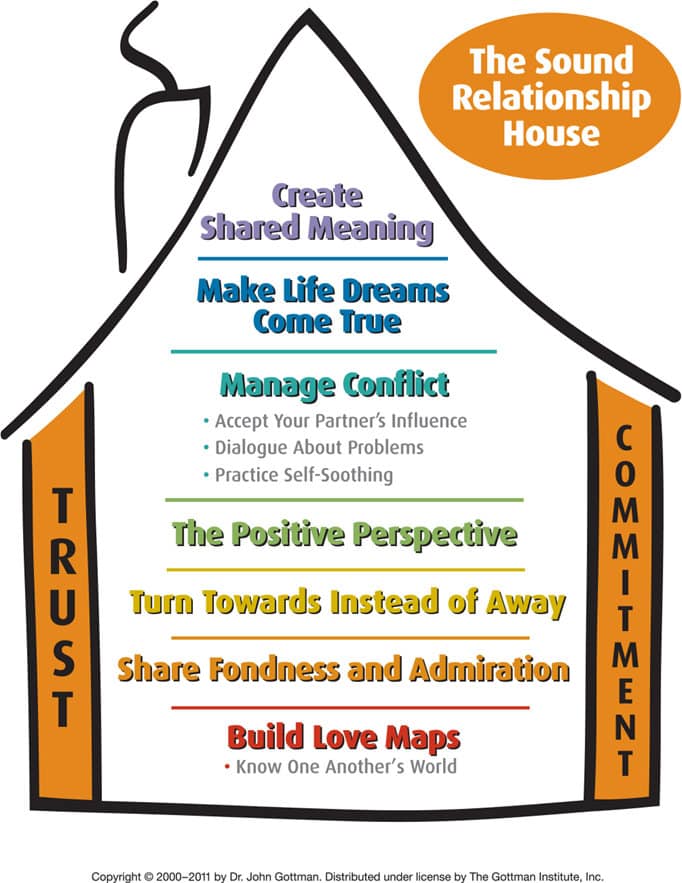
The Gottman Sound Relationship House is a model that illustrates the building blocks of a healthy relationship. Just as a physical house requires a strong foundation before walls and a roof can be built, healthy relationships require certain emotional and relational foundations before trust, intimacy, and long-term stability can flourish.
Each level of the house represents an important relationship skill. The lower levels create the foundation for the levels above them. When these foundational skills are weak, couples often find themselves feeling disconnected, misunderstood, or stuck in recurring conflicts.
The model highlights seven key areas that help couples create stronger emotional bonds, navigate conflict more effectively, and build a meaningful life together.
Take a look at the model below. We’ll break down each level of the house and explain why it matters.
Build Love Maps: Never Stop Learning About Your Partner
The foundation of the Sound Relationship House is what the Gottmans call Love Maps. A Love Map is your understanding of your partner’s inner world—their hopes, fears, stresses, goals, values, preferences, relationships, and life experiences.
One of the most common misconceptions in long-term relationships is that we eventually know everything about our partner. In reality, people continue to grow and change throughout their lives. Careers evolve, priorities shift, children arrive, losses occur, and new dreams emerge.
Healthy couples remain curious about each other. They continue asking questions, checking in, and learning about the person sitting across from them. When partners stop paying attention to each other’s internal worlds, emotional distance often begins to grow.
Strong Love Maps help partners feel understood, supported, and connected. They create the foundation upon which the rest of the relationship is built.
Trust and Commitment: The Walls That Protect the Relationship
If Love Maps create the foundation, trust and commitment form the walls of the Sound Relationship House.
Trust is not built through grand gestures. More often, it develops through thousands of small interactions over time. Trust grows when partners follow through on promises, respond to each other’s needs, communicate honestly, and consistently demonstrate that the relationship is important.
Commitment is the decision to prioritize the relationship even during difficult periods. Every long-term relationship experiences stress, conflict, disappointment, and moments of disconnection. For some couples, unresolved past experiences or trauma can make trust especially difficult to rebuild. In these cases, individual work through Trauma Therapy can complement couples counseling. Commitment allows couples to continue investing in the relationship when circumstances are challenging.
When trust and commitment are strong, couples are better able to weather life’s inevitable difficulties without feeling as though the entire relationship is at risk.
Fondness and Admiration: Remember What You Appreciate About Each Other
Many struggling couples spend so much time focusing on problems that they lose sight of what they value in one another.
Fondness and admiration involve intentionally recognizing and expressing appreciation for your partner’s strengths, efforts, and positive qualities. This does not mean ignoring problems or pretending everything is perfect. Rather, it means maintaining a balanced perspective that includes both frustrations and appreciation.
Couples who regularly express gratitude and appreciation tend to build greater resilience during periods of stress. They are more likely to interpret each other’s actions generously and less likely to view one another as adversaries during conflict.
A healthy relationship requires more than solving problems—it requires actively nurturing positive feelings toward one another.
Turn Toward Instead of Away
One of the Gottmans’ most influential findings involves what they call bids for connection.
Throughout the day, people make small attempts to connect with their partners. A comment about their day, a request for attention, a joke, a question, or a simple observation can all be bids for connection.
When partners consistently respond to these bids, emotional intimacy grows. When bids are repeatedly ignored, dismissed, or rejected, emotional distance often develops.
Turning toward your partner does not require grand romantic gestures. It often involves simple moments of attention, curiosity, and responsiveness that communicate, “You matter to me.”
Over time, these small moments accumulate and create a stronger emotional bond.
Develop a Positive Perspective
Relationships are shaped not only by what happens but also by how partners interpret what happens.
When relationships are healthy, couples often give each other the benefit of the doubt. They assume positive intent, recover more quickly from misunderstandings, and view conflicts as problems to solve together.
When relationships become distressed, the opposite often occurs. Neutral interactions are interpreted negatively, small frustrations become larger conflicts, and partners may begin expecting disappointment.
Developing a positive perspective does not mean ignoring real problems. It means maintaining a view of your partner and relationship that allows room for goodwill, understanding, and repair.
Conflict Is Inevitable—Learning to Manage It Is What Matters
Many couples believe healthy relationships should involve very little conflict. In reality, conflict is a normal part of every close relationship.
Two people will never agree on everything all the time. Differences in personality, values, communication styles, family backgrounds, and life experiences naturally create disagreements.
The goal is not to eliminate conflict but to manage it effectively. Many couples are surprised to learn that recurring arguments often have deeper emotional roots. Understanding these patterns is one reason Couples Counseling can be so effective. Healthy couples learn to regulate their emotions, communicate respectfully, listen to understand rather than simply respond, and work together to solve problems.
Some disagreements can be resolved. Others may become ongoing differences that require compromise, acceptance, or creative solutions. Successful relationships are not defined by the absence of conflict but by how couples navigate it together.
Support Each Other's Dreams and Create Shared Meaning
The highest levels of the Sound Relationship House focus on helping partners create a life that feels meaningful both individually and together.
Healthy relationships are not simply about avoiding conflict or staying together. Strong relationships help people grow. Partners support each other’s goals, encourage each other’s development, and create space for individual dreams while also building a shared vision for the future.
Shared meaning develops when couples intentionally create traditions, values, goals, and experiences together. This might include building a family, traveling, pursuing shared hobbies, participating in a faith community, or simply creating routines that strengthen connection.
The strongest relationships are often built by people who are not only committed to each other, but also committed to creating a meaningful life together.
How Can You Strengthen Your Relationship?
The Sound Relationship House is not a checklist that must be completed in order. Most couples have strengths in some areas and opportunities for growth in others.
Some couples need to improve communication and conflict management. Others need to rebuild trust after a difficult experience. Some relationships simply need help reconnecting after becoming overwhelmed by work, parenting responsibilities, health concerns, or the demands of everyday life.
The good news is that relationship skills can be learned. With awareness, effort, and support, couples can strengthen emotional connection, improve communication, and build a healthier relationship regardless of where they are starting.
New Relationships: Build Healthy Habits Early
Many couples wait until problems become significant before seeking support. However, one of the best times to strengthen a relationship is early in its development.
Learning how to communicate effectively, resolve conflict respectfully, and understand each other’s needs can prevent many common relationship problems from developing later. Building strong Love Maps, learning to turn toward each other, and creating healthy communication habits early often creates a stronger foundation for the future.
Just as people invest in education, fitness, or career development, investing in relationship skills early can pay dividends for years to come.
Long-Term Relationships: Reconnect and Strengthen What Already Exists
Long-term relationships naturally experience periods of distance and disconnection.
Life responsibilities such as careers, parenting, financial stress, caregiving, and health concerns can slowly shift attention away from the relationship. Over time, couples may begin feeling more like roommates, coworkers, or co-parents than romantic partners.
Relationship work is not only for couples in crisis. Many couples seek counseling because they want to strengthen communication, deepen emotional intimacy, improve conflict management, or simply feel more connected again.
Healthy relationships require ongoing attention and maintenance just like any other important part of life.
Troubled Relationships: Repair Is Often Possible
Many couples seek counseling after months or years of frustration, disconnection, recurring arguments, or broken trust. Sometimes emotional distance shows up as numbness, disconnection, or feeling like you’ve become roommates rather than partners.
When relationships become distressed, partners often develop negative assumptions about each other. Conversations become more defensive, misunderstandings become more frequent, and attempts to reconnect may stop altogether.
The encouraging news is that many struggling relationships can improve when both partners are willing to understand what is happening and learn new ways of interacting. Relationship counseling can help couples rebuild trust, improve communication, strengthen emotional connection, and repair damage that has accumulated over time.
While not every relationship can or should be saved, many couples are surprised by how much improvement is possible when they begin addressing problems directly.
Couples Counseling in Fairfax, VA
Every relationship experiences challenges. Whether you are preparing for marriage, hoping to strengthen a healthy relationship, or working through ongoing conflict and disconnection, couples counseling can provide practical tools and guidance to help you move forward.
At The Pragmatic Therapist, we use Gottman Method Couples Therapy and other evidence-based approaches to help couples improve communication, rebuild trust, deepen connection, and create healthier relationships.
If you are interested in learning more about couples counseling, contact us today to schedule a consultation.
Frequently Asked Questions About The Gottman Sound Relationship House
What is the Gottman Sound Relationship House?
The Gottman Sound Relationship House is a research-based model developed by Drs. John and Julie Gottman. It outlines the key ingredients of healthy relationships, including friendship, trust, commitment, conflict management, emotional connection, and shared meaning. Each level of the house represents a skill that helps couples build stronger and more resilient relationships.
What are Love Maps in a relationship?
Love Maps refer to how well you know your partner’s inner world. This includes their hopes, dreams, fears, stresses, values, and daily experiences. Healthy couples continually update their understanding of one another because people grow and change throughout life.
How does Gottman Method Couples Therapy work?
Gottman Method Couples Therapy helps couples strengthen communication, improve conflict management, rebuild trust, deepen friendship, and create stronger emotional connections. The approach is based on decades of research identifying the habits and behaviors that contribute to long-term relationship success.
Can couples counseling rebuild trust?
Yes. Trust can often be rebuilt when both partners are willing to understand what happened, communicate openly, and consistently demonstrate reliability over time. Couples counseling provides a structured environment to address trust injuries and develop healthier patterns moving forward.
Is conflict normal in healthy relationships?
Absolutely. Healthy relationships are not defined by the absence of conflict. Every couple experiences disagreements. What matters most is how partners manage conflict, repair misunderstandings, and maintain respect and connection during difficult conversations.
How do I know if couples counseling could help us?
Couples counseling can be beneficial if you find yourselves having the same arguments repeatedly, feeling emotionally disconnected, struggling with trust, experiencing communication difficulties, or simply wanting to strengthen an already healthy relationship. Many couples seek counseling proactively rather than waiting until problems become severe.
Is the Gottman Method evidence-based?
Yes. The Gottman Method is one of the most extensively researched approaches to couples therapy. The Gottmans have spent decades studying thousands of couples to identify the behaviors and patterns associated with relationship success, stability, and satisfaction.